Blog by Mathew Morris.
Today we celebrate the renaming of the Archaeology and Ancient History Building at the University of Leicester after the pioneering archaeologist Dame Kathleen Kenyon. The Kathleen Kenyon Building is the first academic building to be named after a woman on the University of Leicester’s campus. To mark the occasion, archaeologist Mathew Morris, revisits a blog he first wrote in 2019, and takes a moment to reflect on the significance of her work in Leicester…

Always happiest when digging up the past, Kenyon also strongly believed in training students and making archaeology accessible to a wider audience. Despite her faults, she did not suffer fools easily and sometimes becoming undone by her own overconfidence and unwillingness to delegate; her meticulous excavations in the 1950s at Tell es-Sultan (the Old Testament city of Jericho) made her world-famous and one of the greatest field archaeologists of her generation.
Whilst a student she was the first female president of the Oxford University Archaeological Society (1928-29) and was later closely associated with the founding and operation of the University of London Institute of Archaeology (1935-62), was Director of the British School of Archaeology in Jerusalem (1951-66) and Principal of St Hugh’s College, Oxford (1962-73). In 1973 she was made a Dame of the British Empire in recognition of her contribution to archaeology. Kathleen Kenyon died in 1978; today she is widely recognised as one of the greatest archaeologists of the 20th century.

In Leicester, she is best remembered for her excavation of the Jewry Wall, one of the city’s most famous landmarks and the largest fragment of Roman civic masonry still standing in Britain. Her excavations were the first large-scale investigation of the Roman town, and the first to apply modern excavation techniques, paving the way for over 80 years of archaeological discoveries in the city.
In March 1936, aged 30, Kenyon was appointed director of excavations at the Jewry Wall in Leicester. She had only been an archaeologist for six years but already had an impressive track record in African, British and Middle Eastern archaeology – including work with Gertrude Caton-Thompson on the Great Zimbabwe in southern Africa, the Roman city of Verulamium (St Albans) in England with Mortimer and Tessa Wheeler, and the biblical site of Samaria in Palestine with John and Molly Crowfoot.
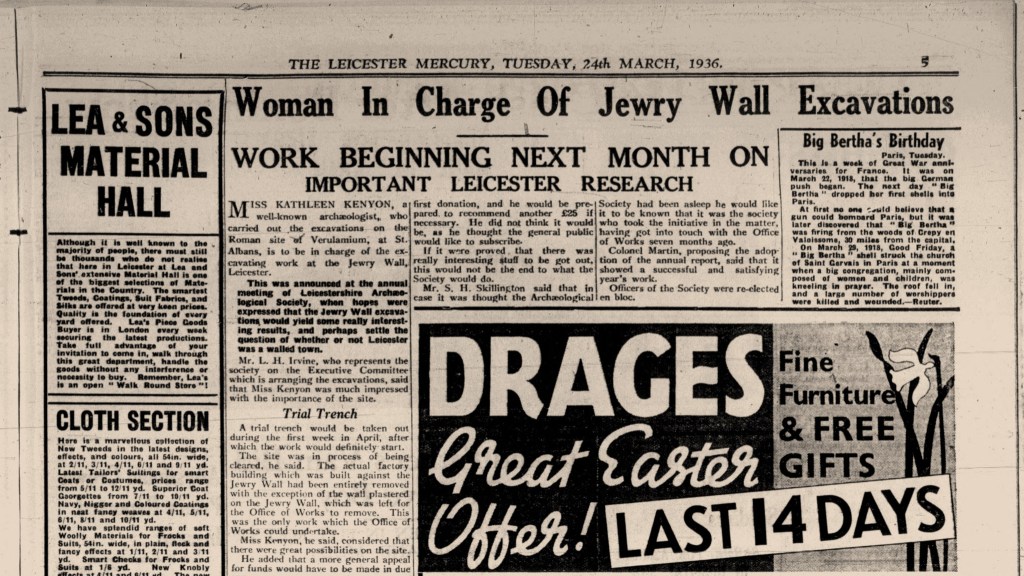
At this time, it was widely acknowledged that the Jewry Wall dated to the Roman period, but there was still no agreement on its function. In 1935 the City Council purchased the factory next to the wall and planned on demolishing the existing buildings to build public baths. Plans were drawn up to excavate the site first, initially funded by local societies, including the Literary and Philosophical Society and the Archaeological and Historical Society, and later (after a public enquiry) by the City Council itself. This made it one of the first ‘rescue’ digs in the country, 60 years before guidance on archaeology and construction began to be issued by the government.

During her first season of excavation, Kenyon established that it was the western side of a large basilica, and quickly concluded that it had been part of the Roman town’s forum (civic centre). In later excavations, Kenyon found the bath buildings, leading her to revise her original interpretation and suggest that the forum was later converted into a bath house. Ultimately, the significance of the discovery meant that in 1937 the city council scrapped its plans for a public bath on the site (voted 33 to 21) in favour of preserving the remains as a public monument.
Did you know?
There is some film footage of Kenyon’s 1936 excavation at the Jewry Wall. You can watch it here https://player.bfi.org.uk/free/film/watch-scenes-in-and-around-leicester-1935-36-1936-online (from 2.14 minutes).
Altogether, Kenyon led four seasons of excavation at Leicester (1936-39). Each April/May the upper layers of modern soil and rubble were removed by workmen under the supervision of an experienced foreman, with Kenyon visiting regularly to check on progress. By mid-June, excavation began on the Roman layers and Kenyon moved to Leicester to directly supervise the 40-50 labourers and volunteers, including locals and students from the Institute of Archaeology, working on the site. Work carried on through the summer to the end of August or September.

Excavations encompassed rooms flanking the ‘entrance’ between the basilica and what Kenyon believed to be the forum’s market square. A large bath building was also found occupying the whole of the open space. Kenyon spent the rest of the excavation wrestling with the interpretation of this unusual arrangement, but never truly came to a satisfactory explanation for the odd arrangement of buildings and the big discrepancies in floor levels between the different rooms.
Initially, she theorised that the market square had, for some reason, stopped being used as such, owing perhaps to changes in commerce in the late Roman period. However, her phasing of the construction of different parts of the site eventually showed that the basilica and bath building were of broadly contemporary mid-2nd century date. This led her to conclude that the ranges of shops that traditionally should have surrounded the market square were never fully realised, probably because of ground subsidence making parts of the site unusable, and that the original forum was repurposed as a public bath, with the basilica becoming the palaestra (gymnasium), and that the forum itself had moved elsewhere in the town.
Even after the bath house was found to be contemporary with the basilica, Kenyon continued to believe that the site was first built as the forum and appears to have never considered the possibility that it was purposefully built as a bath house. Archaeologists found the real 2nd-century forum beneath what is now Jubilee Square, east of the Jewry Wall site, in the 1960s, and it is now accepted that the Jewry Wall was always part of the town’s public baths.

This, however, does not diminish Kenyon’s contribution to our understanding of Leicester’s story. Far from it in fact. Whilst she was quick to make up her mind and slow to change it, given the evidence available at the time her interpretation was not unreasonable, and her report was a pioneering attempt to date the main phases of the site using pottery. Beneath the Roman remains, she also found the first conclusive proof that the Roman town occupied the site of a late Iron Age settlement, an important contribution to the study of the relationship between pre-Roman and Roman settlements in Britain, a hot topic at the time.
The Jewry Wall excavation was Kenyon’s first major independent fieldwork project and gave her a chance to perfect her methodology for stratigraphic excavation, first learnt under the tutelage of the Wheelers at Verulamium and then applied to her own work at Samaria. She did this despite the indifference of her peers who, in her opinion, had a poor understanding of the importance of stratigraphy in understanding a site’s chronological development (the principle, derived from geology, that upper layers or strata are more recent than lower strata).

Her method was perfectly suited to digging a complex urban site, such as the Jewry Wall, where thousands of years of history overlapped and intruded through each other. She would continue to refine the Wheeler Method of excavation throughout her career, so today it is known as the Wheeler-Kenyon Method, earning her the sobriquet ‘Mistress of Stratigraphy’.
When she finally published the Jewry Wall excavations in 1948 (the delay in publication was due to the Second World War) even her critics, who felt she had jumped to her conclusions too quickly, praised her final report for its careful and thorough cataloguing and publication of the material from the excavation, particularly the pottery. As one reviewer wrote: ‘Miss Kenyon’s straightforward and clear account of a difficult piece of work is as admirable as the excavation itself.’ Because of this, and because of her meticulous excavation and recording techniques, archaeologists today are still able to re-evaluate her findings as new discoveries come to light and gain new insights into the ever-developing story of Leicester in the Roman period.

Further reading
KENYON, K. 1948, Excavations at the Jewry Wall Site, Leicester. Oxford: Report of the Research Committee of the Society of Antiquaries 15.
MCKINNEY, M. 2003, Kathleen Kenyon: Larger Than Life at https://www.vision.org/kathleen-kenyon-larger-life-486 [accessed 17/02/2019]
THUSHINGHAM, A.D. 1985, ‘Kathleen Mary Kenyon: 1907-1978’ in Proceedings of the British Academy 71, 555-82
Kenyon excavation photographs courtesy of Leicestershire, Leicester and Rutland Record Office. Re-colourisation using colourize-it.com.
Blog originally published 08/03/2019; updated 07/03/2025
 ULAS News