Blog by Gavin Speed and Andrew McLeish.
A unique – and fragile – Roman key handle portraying a ‘Barbarian’ grappling with a lion will soon go on display in the newly refurbished Jewry Wall Museum in Leicester. It was once a high-status Roman item, and no other quite like it has ever been discovered. Because it is so rare, and very fragile, it cannot be handled by visitors. Instead, new technologies and specialist artistic skills have been used to create remarkably realistic life-size replicas which have been donated to Leicester Museums and Galleries for use during school visits and other special events. These will give visitors the unique opportunity to interact with the artefact beyond the display case and immerse themselves in discoveries from Roman Leicester in new and engaging ways. In this blog, ULAS archaeologists Dr Gavin Speed and Andrew McLeish discuss how the original handle was found and how the replicas came about.
Discovery
In 2017, ULAS undertook one of the largest ever archaeological excavations in Leicester, on the site of the former Stibbe and Maxim Building (north of Friars Causeway, off Highcross Street). The dig discovered Roman buildings, mosaics and streets. Remarkably, beneath a later Roman floor surface, was an unusually decorated cast copper-alloy key handle (you can read more about the key handle in our earlier blog here).
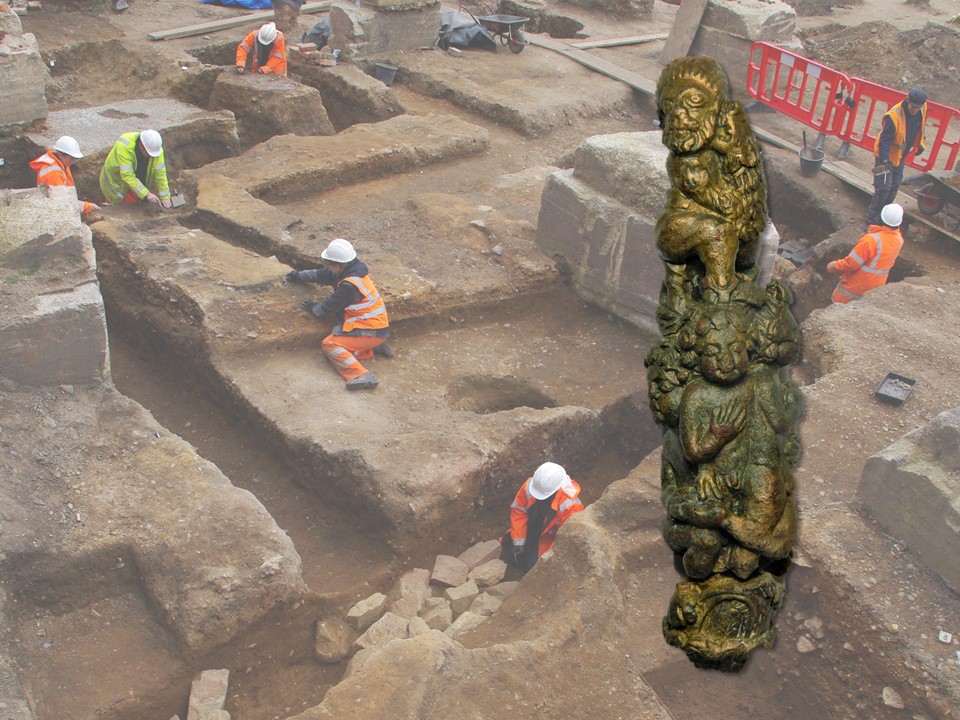
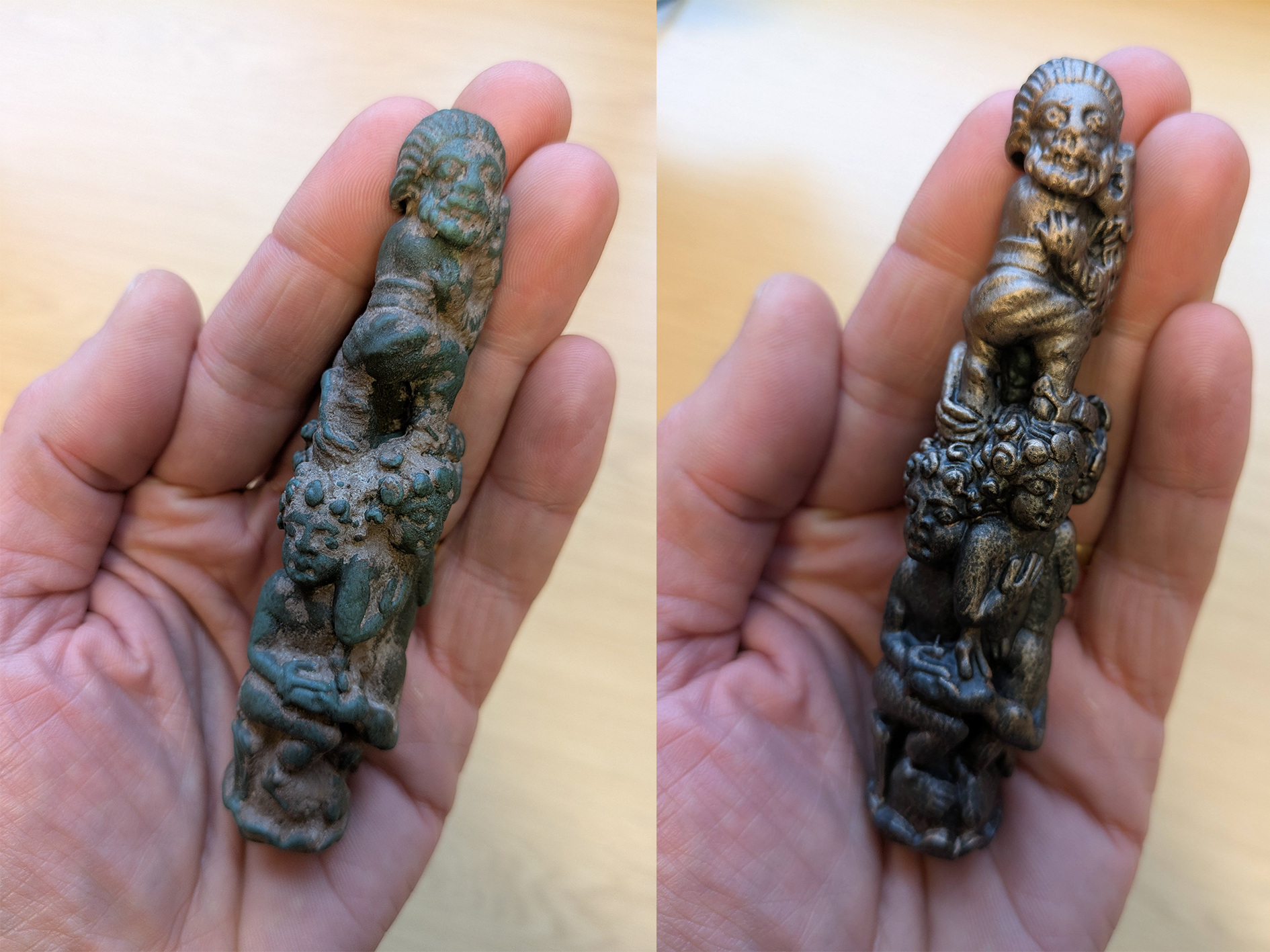
The key handle depicts two groups of figures. On the top a bearded, unarmed man fighting with a lion, and below four naked male youths embracing one another. This decoration cannot be paralleled among other similarly elaborate Roman key handles, and this special object will soon have pride of place on display in the new-look Jewry Wall Museum in Leicester for all to see.
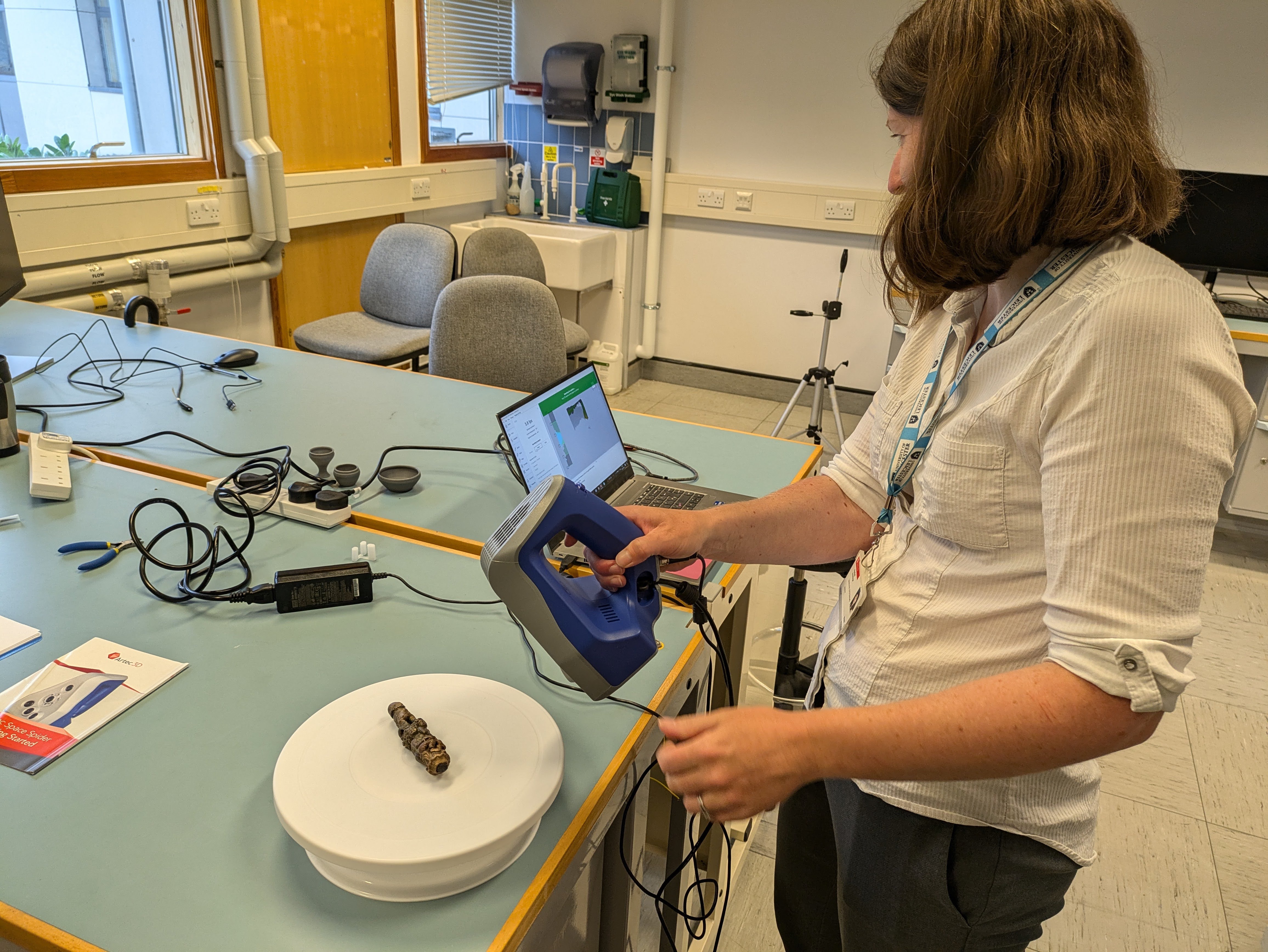
Leicester Museums and Galleries approached ULAS asking if a 3D model existed of the key handle, to use in virtual displays, and new facilities at the University of Leicester’s School of Archaeology and Ancient History allowed us to not only scan the object to create a detailed digital 3D model, but also to create 3D printed replicas. With this in mind we offered to make the Museum some replicas for use as handling objects.
3D Scanning
The digital 3D model was created using hi-tech equipment at the School of Archaeology and Ancient History. Thanks to Dr Rachel Armitage (SEM Technician & Technical Services Manager), thousands of photos were taken (using a tool that looks like an iron!). These images were then digitally stitched together to form the highly detailed digital 3D model. Explore the model yourself below!
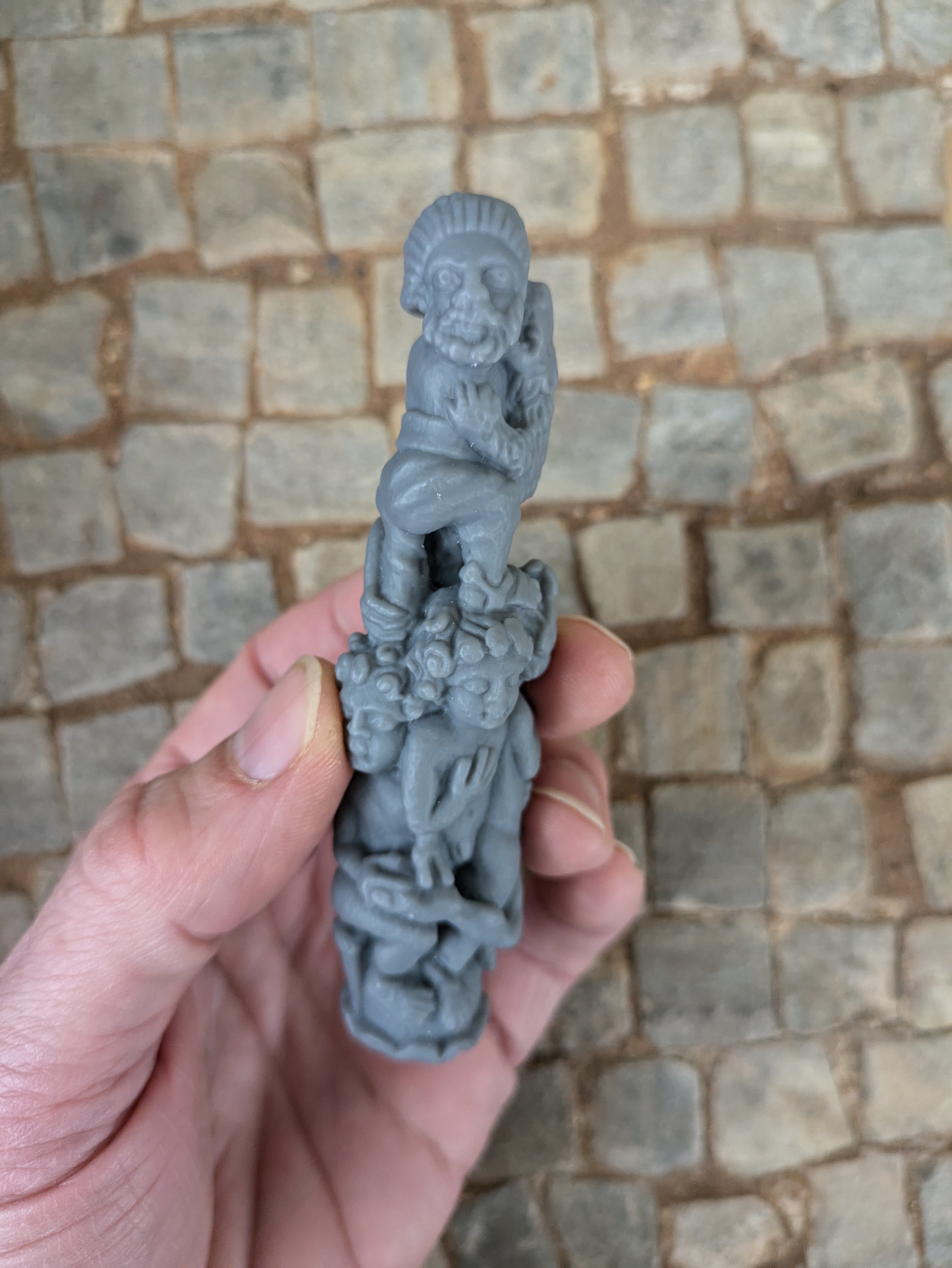
The model was then 3D printed in resin. The print gave a good, solid, pretty accurate representation of the original artefact which was safe to handle. If it gets dropped and broken, it’s quite a simple to print off a replacement. But ultimately it was still grey resin. To make it into something more visually interesting for people to handle we required someone with a high level of artistic skill to paint the replicas. Fortunately Andrew McLeish has that skill (thanks to his love of model kit building). We asked him if he fancied an ‘interesting challenge’, to paint one replica ‘as found’ when initially excavated in 2017, and two others to look like the current conserved handle.

Painting the key handles – Andrew McLeish
I was lured in with the dangle of ‘an interesting challenge’ and it most certainly was challenging to replicate all the different colours of both the metallic tones of the ‘as found’ and ‘conserved’ artefact, and blend all the changes depending on the levels of cleaning and stabilised corrosion.
For the ‘conserved’ handle I started with a black enamel undercoat for the paints and lacquers to ‘grip’ onto and to remove any visible sign of the printing resin. When this had set it was followed by lacquers in various dark metallic shades (which I normally use on natural metal finishes on aircraft!) airbrushed lightly. These give a worn metallic finish, where the surface corrosion has been cleaned off, but the metal hasn’t been polished. Then a very light misting with an airbrush of green enamel of a shade suitable for verdigris where corrosion has been stabilised but not removed entirely. Which only gets us to the end of stage 1!
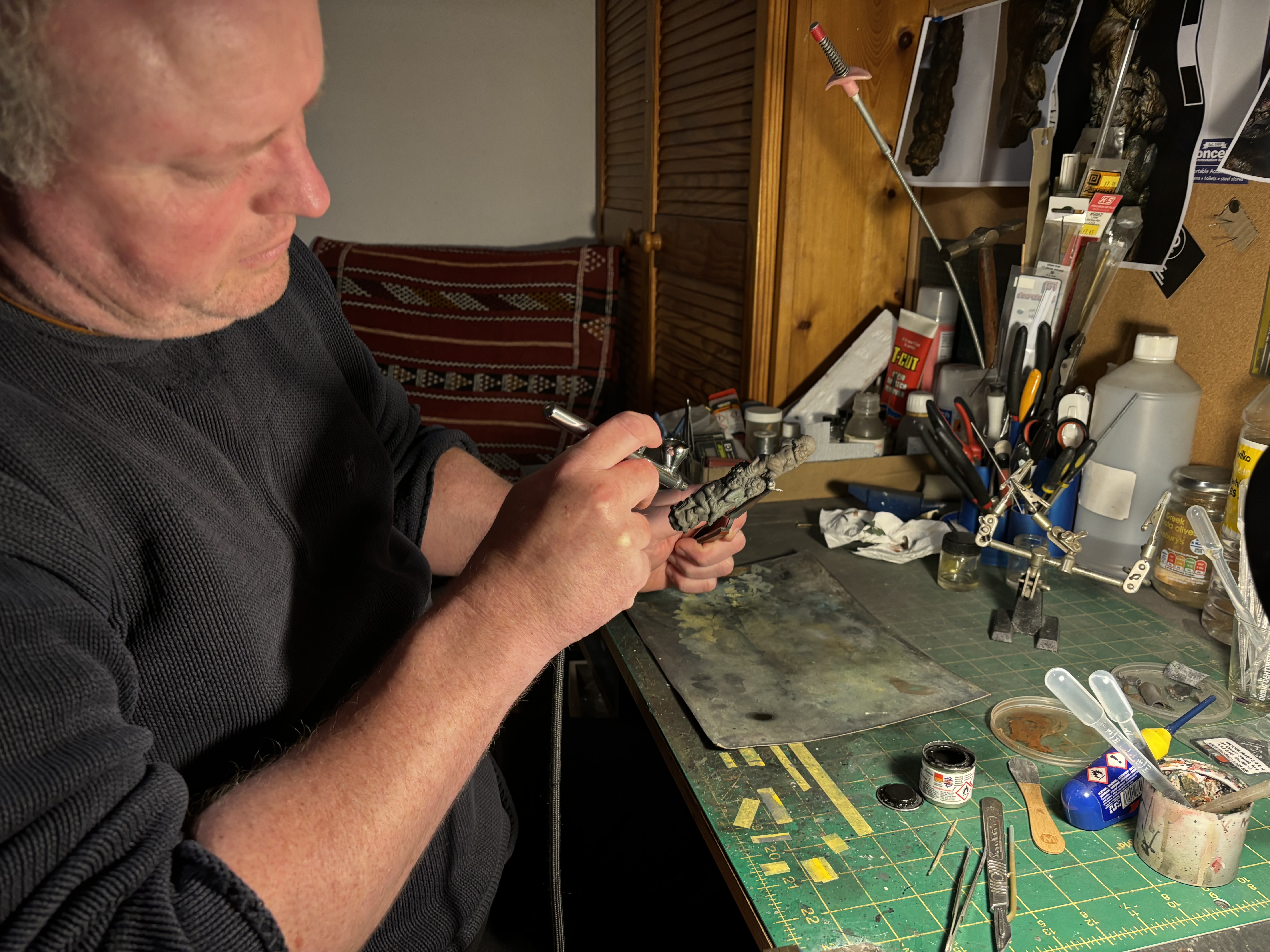

The second stage began with a switch to a traditional brush, to bring up surface highlights where the conservator had brought out the original metal colour, or where areas had been handled and a slight sheen had appeared on the surface. To achieve this a technique known as dry brushing was employed. Dry brushing is a form of highlighting which brings out textures by showing light and shadows. Modellers often do it to highlight details which on the real thing would be much more visually prominent and to highlight the level of detail on a model. Simply put, the paintbrush is lightly dipped into the paint of choice before wiping off almost all of the paint onto a dry paper towel. It is important to keep going until almost no paint comes off and the brush should look like there’s almost no paint on it. To get the desired effect one must brush across the surface very lightly, repeatedly, back and forth. Before long there will be an area of detail that gets highlighted. Several sessions of this with appropriate shades of paint are required.
To replicate the just out of the ground look of the ‘as found’ handle required some different techniques. Because the 3D scanning and printing process was done with the conserved artefact some of the surface texture and irregularities of the original caused by its long spell in the ground tended to be smoothed out and lost. To try and recreate the effect of the original, as it was excavated, I needed to either try and regain some surface texture, or hide some of the smoothness. What eventually happened, after some trial and error, was a combination of the two.
With the conserved handles a black undercoat worked better for the metallic shades built up over it, with this ‘as found’ handle we were trying to represent a copper alloy object with millennia of corrosion. In this instance a mixture of browns and greens were irregularly sprayed onto the print to give a base colour. Onto this a layer of gloss varnish was then sprayed and while wet 300-micron grit was dusted onto it in places with an old tea strainer to roughen the surface texture of the print before further varied coats of green were added.


The artefact when excavated also still had dirt embedded into all its nooks and crannies. To recreate this, I could have just covered the print in mud and rinsed it off but over time that wouldn’t be stable, especially if the item was to be handled often. We needed something which looks like site dirt but would last longer, the end result was a mixture of decorator’s filler, powder paint and 300-micron fraction residue courtesy of processed soil samples from the ULAS finds lab! The bulk of this was then wiped off immediately, then left to dry. This was followed by judicious application of an old toothbrush to remove more of the mixture until the original colour came back through and the remains of the ‘dirt’ were in the recesses as per the original when it came out of the ground.
The ‘as found’ handle was completed in the same way as the other ‘conserved’ handles, although when you are mixing paint by eye there will be subtle differences in the finished items. This of course has the added side benefit of identifying them as replicas rather than forgeries! All three key handles were finally treated to three coats of varnish to protect the paintwork from handling for as long as possible.
Gavin Speed is a Project Manager at University of Leicester Archaeological Services (ULAS) with more than 20 years of archaeological experience on a range of archaeological projects both in the UK and abroad. He also shares his expertise with archaeology students on their fieldwork modules. Discover Archaeology and Ancient History at Leicester.
Andrew McLeish is a Project Office at ULAS, and has been involved in archaeology for over 15 years across the UK and abroad. He has extensive experience in urban archaeology, most recently on the Stibbe and Waterside projects in Leicester, and at the Coventry Charterhouse. In his spare time he is a keen railway modeller (an invaluable skill when replicating Roman artefacts!).
Find out more:
The original Roman key handle will be on public display in the Jewry Wall Museum in Leicester, due to reopen later in the year. One handle replica will remain with ULAS, to feature in future public events, the other two have been gifted to Leicester Museums and Galleries for use in school visits and similar events.
The key handle features in our book ‘Secrets from the Soil’, available at shop@le. You can also read more about the key handle in this article or on ULASNews here:
Pearce J, Speed G, Cooper NJ (2021), ‘At Death’s Door: A Scene of Damnatio ad Bestias on a Key Handle from Leicester’ in Britannia. 2021;52:327-342 https://doi.org/10.1017/S0068113X21000118
 ULAS News