The settlement of the cottages
In April 2023, homeowners and volunteers excavated 11 test pits across Near and Far Coton. Over 1,500 individual finds were recovered, ranging in date from the Bronze Age to the present day.
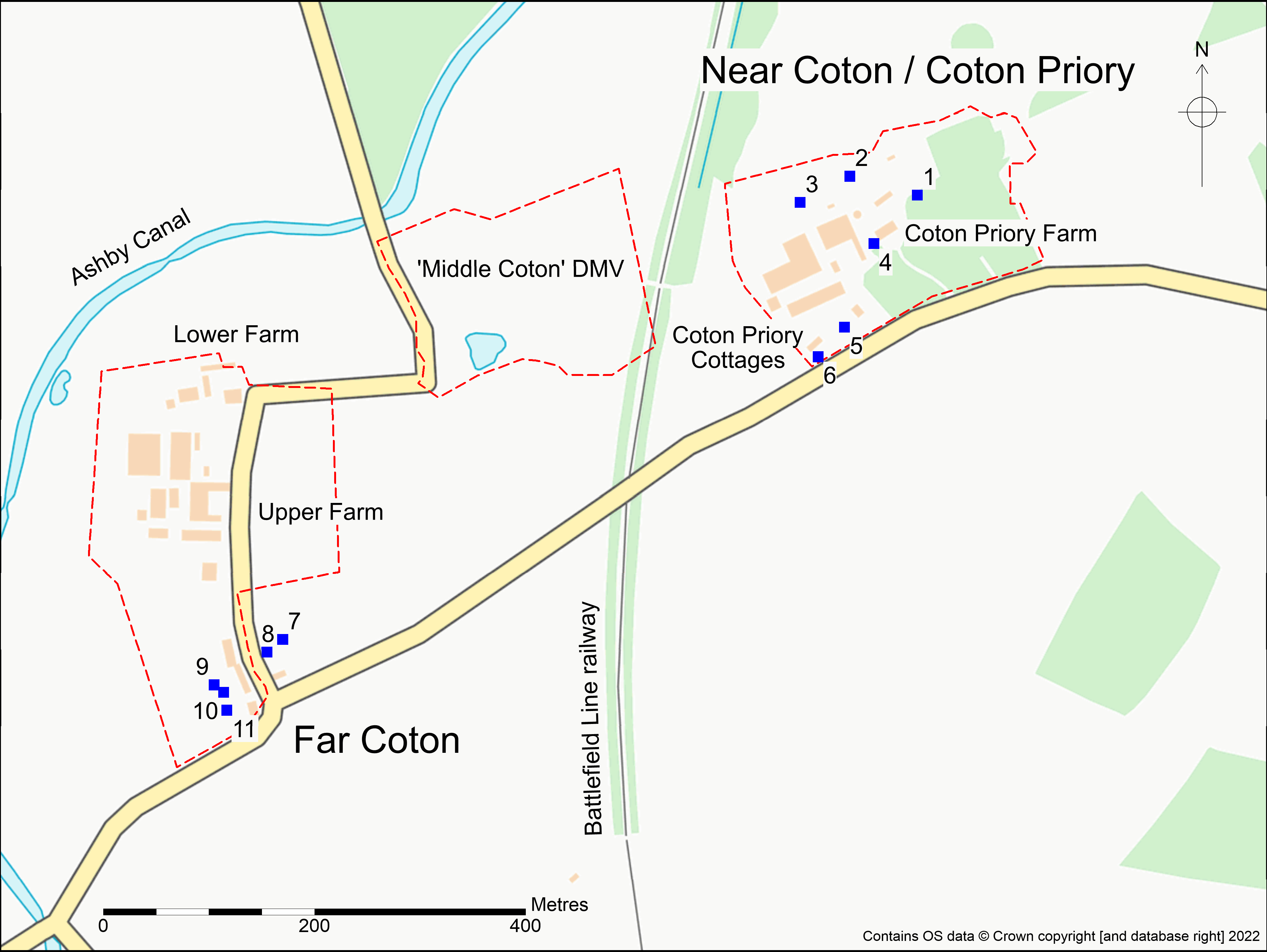
Overall, the test pits produced evidence for medieval agriculture from the 12th century onwards, and medieval occupation at Near Coton from the 15th century onwards, as well as tantalizing hints of earlier Bronze Age and Roman landscapes. The distribution of pottery from the test pits suggests that much of the area was given over to arable cultivation in the medieval period, enriched with domestic refuse, with land being given over to pasture from the 15th or 16th century onwards. At Far Coton, settlement was probably to the north of the study area in the vicinity of Upper and Lower Farm. At ‘Middle Coton’, the earthworks listed on the Historic Environment Record as deserted medieval settlement were more likely to be post-medieval field boundaries and modern earth movement, whilst at Near Coton medieval occupation did not appear to pre-date the 15th century. However, 15th century activity at Near Coton does suggest that settlement here is much earlier than previously attested, and 50-200 years earlier than the extant 17th century Coton Priory Farm.
A slight scatter of Bronze Age lithics represented a low-level ‘background noise’ of prehistoric activity in the wider landscape. Similarly, the small assemblage of Roman pottery also represented activity in the wider landscape, probably associated with Roman settlement sited to the north-east, closer to Market Bosworth.
Watch a short film about the project, produced by filmmaker Bill Newsinger.
Find Out More:
- Download the test pit report here (pdf, 15mb)

 ULAS News