Projects led by Leicester archaeologists are to be showcased on the new series of BBC Two’s primetime TV series Digging for Britain in the New Year.
Three University of Leicester Archaeological Services (ULAS) projects from across Leicester, Leicestershire and Rutland are to feature on the latest series, presented by Professor Alice Roberts.
The major discovery of a one-of-a-kind Roman mosaic on Rutland farmland will be the focus of the first episode to be broadcast on January 4th at 8pm, following the Leicester team and undergraduate archaeology students as they painstakingly uncover part of the story of Greek hero Achilles.

The 11m by 7m mosaic is the centrepiece of a newly discovered Roman villa complex comprising a range of buildings including a domestic focus, aisled barns, circular structures and what is thought to have been a bath house. The mosaic is unique in the UK, and one of only a handful from across Europe, to show Achilles’ battle with Hector at the conclusion of the Trojan War.
The story of an elaborately-decorated Roman bronze key handle excavated by ULAS experts at a site off Great Central Street in Leicester will feature in the fourth episode of the series, to air on January 11th.
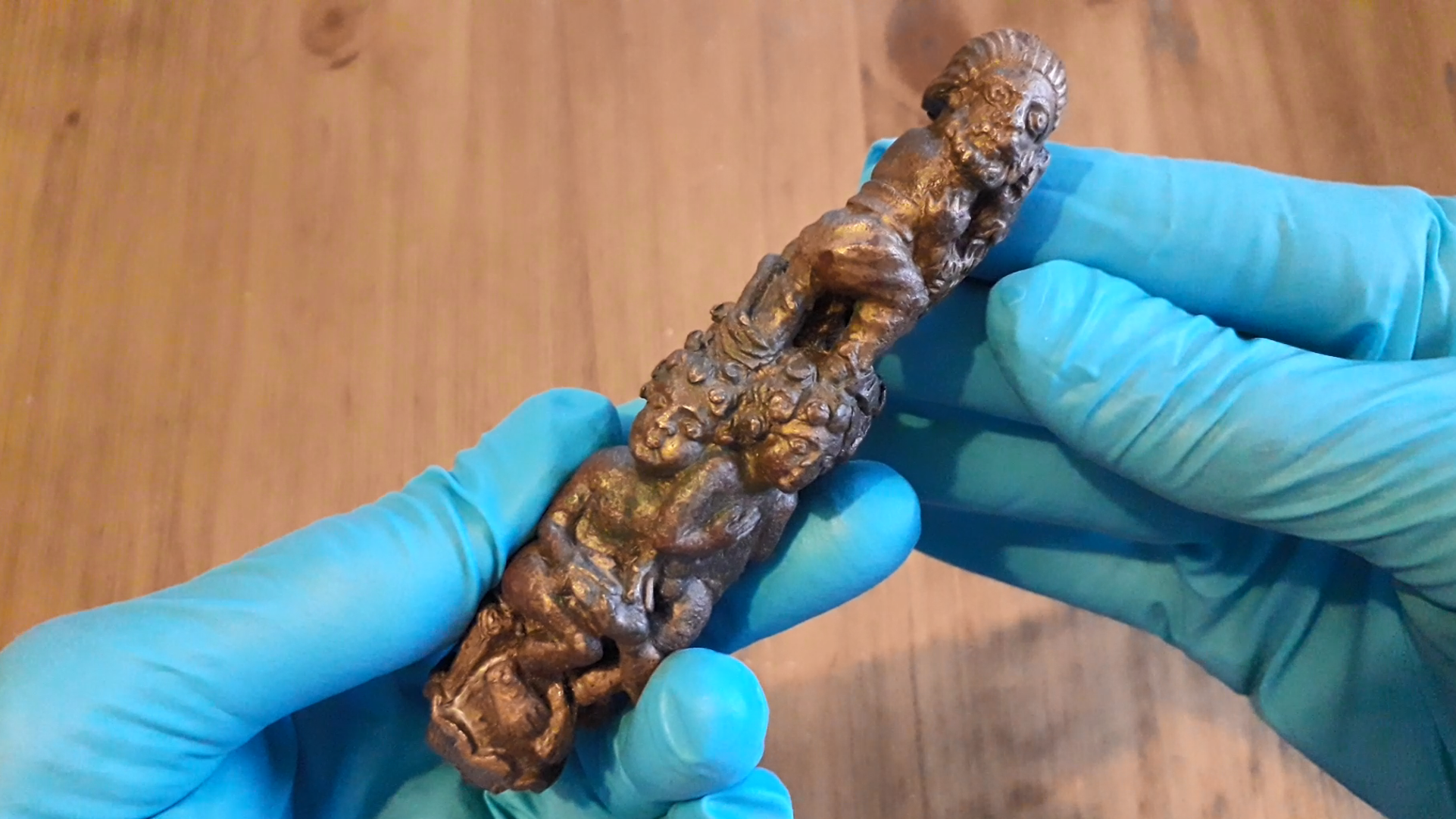
The handle portrays a ‘Barbarian’ grappling with a lion, together with four naked youths cowering in terror. It is among the first evidence from Roman Britain of executing captives by ‘throwing them to the lions’.
An excavation at Castle Hill Country Park is the third Leicester project, and will also feature in the fourth episode of the new series, investigating remains of a manor linked with the medieval Order of Knights of the Hospital of Saint John of Jerusalem, commonly known as the Knights Hospitaller.

While the Hospitallers are familiar by name, their sites are largely unexcavated in the UK – making this a rare opportunity to explore this type of monument.
The project, involving volunteers from the local community and nearly 70 students from the School of Archaeology and Ancient History as part of their fieldwork module, concentrated on the Manor House site and its outer enclosure, and uncovered evidence of a large timber-framed hall with leaded windows and a tiled roof as well as many artefacts from the 13th and 14th Centuries.
John Thomas is Deputy Director of ULAS and also managed the Rutland dig. He said:
“ULAS is one of only a handful of UK archaeological units that operate in a university environment, and the variety of expertise that offers gives us many opportunities for collaborative working. We’re really pleased to have worked with the School of Archaeology & Ancient History to provide vital student training on such wonderful archaeological sites. To have three of our projects making a significant contribution to Digging for Britain is fantastic for everyone – hopefully the stories that are told about them will inspire future generations of archaeologists who will doubtless make exciting discoveries of their own.”
University of Leicester Archaeological Services (ULAS) is an award-winning commercial archaeological unit that undertakes contracts across the UK.
The team features experts from a number of different archaeological fields, and works closely with academic staff from the University’s School of Archaeology and Ancient History.
Leicester Archaeology students have the opportunity to gain valuable practical and professional experience with ULAS specialists during their studies.
Digging for Britain airs on BBC Two from 4th January, at 8pm and is also available on iPlayer.
 ULAS News
The figure of the lion eating the man is St Ignatius. The children below him are the disciples who inherit the globe (which the boy is holding) (as described in Ignatius’ letters to the Romans.). The artefact is important because it is the first depiction of St.Ignatius and as a result dates his execution and the use of lions in his execution, and documents the rapid spread of the event throughout the then known world.. Paradoxically using the new Roman methods of communication. I am guessing that it may have been made as a memento of the event, actually made at the colliseum in Rome and brought to Britain in 1017 immediately after Trajans’ reign and at the start of Hadrian’s. Likely left were it is in Leicester by the sack of Leicester by the (pagan) Brigantes, and the uprising the reason that Hadrian came to Britain. A very importrtant relic, because of it’s context – o the Christian church. And indeed to history itself.
Peter Reynolds
correction should read 117AD
Also perhaps it was on the top of a crucifix. Could it be related to a relic of St Ignatius himself? – brought from Rome. Could it also relate to the ninth legion?
The glode might be syncretist with respect to for example Jupiter. Symbolic of the universe,
Might have been a part of a portable altar with an iron support.
Another possibility is that it was hidden or buried either when Septimius Severus came to Britain in 208AD, or in anticipation of him coming. Given that Severus defeated the British legions in Gaul, in his ascent to power, and was notorious for his persecution of the Christians. It should be possible to identify if it was produced at the Colosseum in Rome, through elemental analysis of the alloy.